
Worthing High School
Always Pursue Excellence
 South Downs Education Trust
Computer Science -Curriculum Information
Curriculum Intent
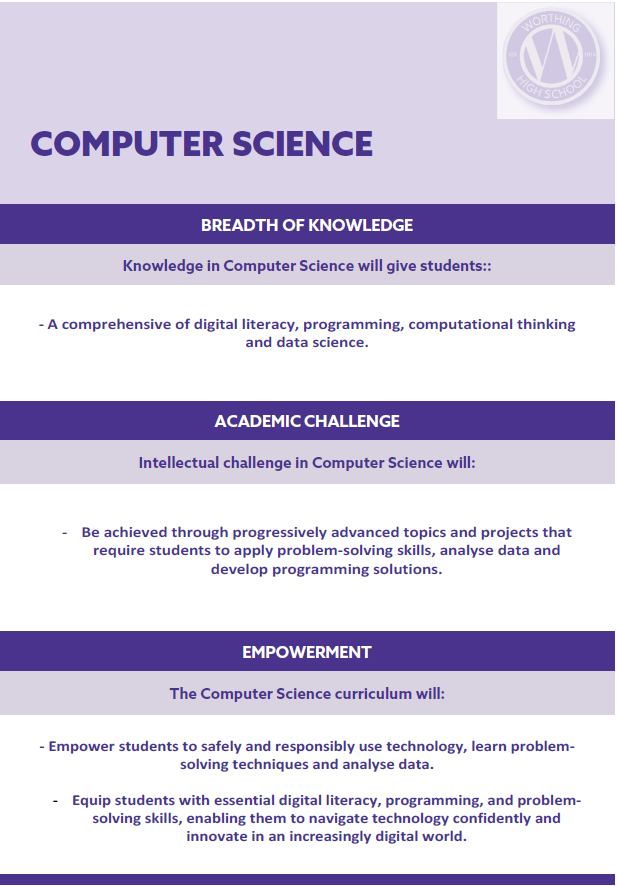
Curriculum Sequencing
Aims of the Computer Science Department
- To enable every student to reach their potential when using computer technology.
- To show how Computer Science relates to the outside world.
- To instil the confidence in our young people to have a go at problem solving using computer technology, no matter how challenging.
- To put Computer Science on the map.
- To encourage our young people to take Computer Science further in their academic life.
Departmental Staff
- Mr S Uddin - Subject Leader IT & Computer Science
- Mr S Townsend
- Mr R Morris
- Mr K Rasarathnam
Facilities
To support the learning of Computer Science and digital literacy at Worthing High, we have a number of ICT suites in school, which are used by students of all ages. We also have mobile tablets supported by a new reliable wireless network.
Our Philosophy
The Computer Science department is one that can be accessed by all. Whilst a challenging subject, we believe a love of independent problem-solving is all you need to succeed: you should constantly question "why?" and "how?". We aim to promote a keen interest in the artificial intelligence around us. Anything can be achieved if you work hard, with enthusiasm and resilience.
Key Stage 3 (Years 7 to 9)
Our KS3 spiral curriculum has a learning approach where all students from Year 7 through Year 9 engage in a consistent sequence of termly projects: Digital Literacy, Computers & Networks, Python 3 Programming, Computational Thinking, and Data Science.
This progressive, spiral approach ensures that students continually build on their prior knowledge, allowing for cumulative learning and embedding of core principles. However, the level of challenge and depth of study increases progressively with each advancing year group, ensuring a well-sequenced and knowledge-rich curriculum.
-
Year 7 students start with foundational concepts and introductory activities to build a secure understanding.
-
In Year 8, students revisit the same topics but engage in more detailed explorations, fostering deeper learning and stronger retention.
-
By Year 9, students are expected to demonstrate mastery of these concepts through more complex tasks, promoting higher-order thinking skills and greater subject fluency.
As KS4, students delve even deeper into the above areas by refining their programming abilities, explore advanced algorithms and data structures, and engage in more complex challenges that require rigorous application of their knowledge. The KS4 curriculum further develops their analytical and evaluative skills, preparing them for higher education or careers in technology with confidence and proficiency.
Overall, the sequential integration of KS3 into KS4 ensures that students graduate with a comprehensive and well-rounded expertise in computer science, ready to meet the demands of a digital future.
|
Term |
KS3 projects |
|
1 |
Digital Literacy This term focuses on building foundational digital literacy skills, emphasizing online safety, responsible internet use, and understanding digital footprints. |
|
2 |
Computers & Networks This project builds on the basic knowledge from Digital Literacy and delves into the hardware and infrastructure of computing, providing a deeper understanding of how computers and networks operate. |
|
3 |
Programming: Python 3 This project provides students with fundamental programming skills, which are crucial for later topics like data science and computational thinking. |
|
4 |
Computational Thinking This project builds upon student programming knowledge and further develop their problem-solving skills. This project will teach students how to approach problems methodically and design algorithms. |
|
5 |
Data Science Once students are comfortable with programming and computational thinking, introduce Data Science. This project leverages their coding skills and analytical thinking to handle data effectively, preparing them for real-world applications. |
|
6 |
End of Year Assessment and Kodu / Advanced Programming Students will undertake an end of year assessment and then move onto Kodu game design or more advanced Python programming using Turtle |
Key Stage 4 (Years 10 to 11)
There are two main strands to the GCSE Computer Science qualification:
-
Paper 1: Principles of Computer Science (written paper)
-
Paper 2: Application of Computational Thinking (practical onscreen examination)
Both papers have identical weighting and mark allocations. More information from exam board Edexel is provided here:
|
KS4 - Year 10 |
||
|
Term |
Computational Thinking |
Principles of Computer Science |
|
1 |
Intro to programming Decomposition, algorithms Data types, variables Input and integer functions, debugging tools Flowcharts Assessment |
Intro to programming Decomposition, algorithms Data types, variables Input and integer functions, debugging tools Flowcharts Assessment |
|
2 |
String manipulation, string methods if, if else, relational operators if elif else, readability Boolean operators Repetition (while) Assessment |
Two’s complement 2 Logical binary shifts Arithmetic binary shifts Hexadecimal ASCII Assessment |
|
3 |
One-dimensional lists for loops, range function Procedures Functions Subprograms Assessment |
Stored program concept Fetch-decode-execute 1 Fetch-decode-execute 2 Secondary storage 1 Secondary storage 2 Assessment |
|
4 |
string.format() Two-dimensional lists Validation Linear search (one-dimensional) Linear search (two-dimensional) Assessment |
Operating systems OS: file management OS: process management "OS: peripherals & user management" Utility software Assessment |
|
5 |
Merge sort Reading files String processing Writing files Authentication Assessment |
Malware & anti-malware Hackers Social engineering Data-level protection Robust software Assessment |
|
6 |
Turtle introduction, pens and lines Turtle movement, coordinates, polygons, subprograms Turtle pens, colours, filling, and circle Turtle, combining subprograms, layers Turtle big problem Assessment |
LANs and WANs Network speed Connectivity Wired vs wireless Network topologies Assessment |
|
KS4 - Year 11 |
||
|
Term |
Computational Thinking |
Principles of Computer Science |
|
1 |
Intro to programming Subprograms Local, global Maths, time Problem solving Assessment |
Embedded systems The Internet of Things Packet switching TCP/IP 1 TCP/IP 2 Assessment |
|
2 |
Trace tables Errors Bubble sort Binary search Problem solving Assessment |
Environmental issues: manufacture & use Environmental issues: e-waste Low-level & high-level languages Translators Intellectual property Assessment |
|
3 |
Data types, string manipulation, validation, testing with data Data structures (one-dimensional) Trace tables Errors Problem solving Assessment |
Bitmaps 1 Bitmaps 2 Representation of sound Representation of sound Compression Assessment |
|
4 |
Data structures (two-dimensional) Subprograms (local, global, procedures, functions) Problem solving Trace tables, errors, flowcharts Problem solving, testing with data Assessment |
AI, machine learning & robotics AI, machine learning & robotics Personal data Privacy Data protection & computer misuse Assessment |
|
5 |
Revision |
Revision |
|
6 |
Exams |
Exams |
Independent Learning
-
At Key Stage 3, students complete termly tasks via Educake
-
At Key Stage 4, students independently learn GCSE topics using the https://courses.exa.foundation
Intervention – Period 6’s
Computer Science P6 intervention is held Tuesday before school in D4 8-8.30am. All students are welcome and some students are specifically invited.