Worthing High School
Always Pursue Excellence
 South Downs Education Trust
Apprenticeship Information
Apprenticeships: Your Guide to Earning & Learning
What is an Apprenticeship?
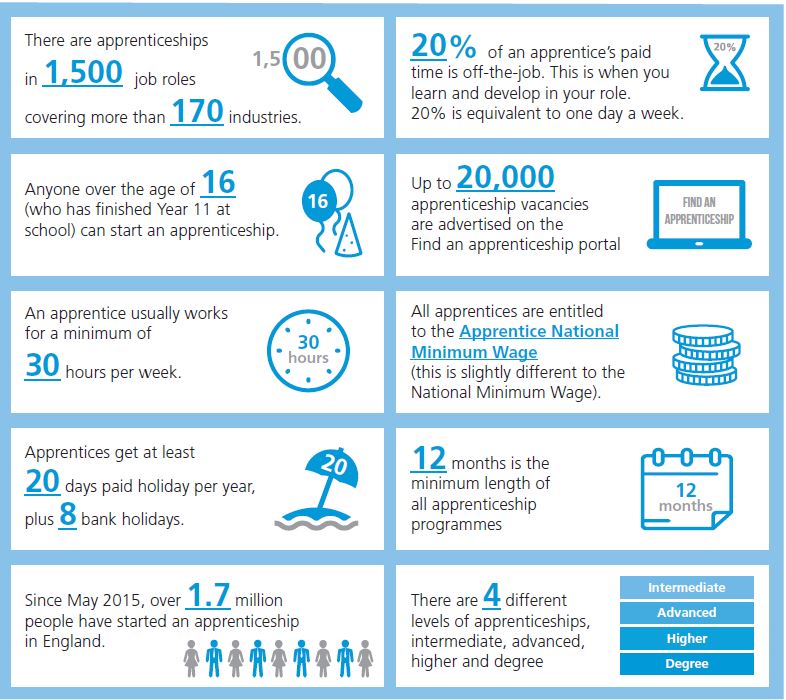
An apprenticeship is a unique opportunity to enter the workforce at age 16 by combining full-time employment with accredited training. As an apprentice, you will spend roughly 80% of your time working on the job with an employer and the remaining 20% training with a local college or specialist learning provider. You will earn a wage from day one, gain real workplace experience, and work towards a nationally recognised qualification. This pathway is perfect for practical, hands-on learners who are ready to step into a professional environment straight after Year 11.
The Details: Wages & Working Hours
- The Apprentice Wage: The National Minimum Wage for an apprentice under 19 (or in the first year of their apprenticeship) is £6.40 per hour. Many employers choose to pay more than this to attract the best candidates, but this is the legal minimum you can expect to start on.
- Working Hours: You will work a minimum of 30 hours per week up to a maximum of 40 hours per week. This total includes the time you spend at college or training, which you are paid for. Because you are under 18, you cannot legally work more than 8 hours a day or 40 hours a week.
The Reality Check: What You Need to Know at 16
Apprenticeships for school-leavers at 16 are highly competitive and fewer than at 18 and can be restricted by age limits in certain technical fields. However, there are excellent opportunities if you know where to look and how to prepare.
1. The Most Common Sectors at Age 16
Many local apprenticeships for school-leavers may require certain minimal GCSE grades and employers will look for enthusiasm, reliability, and a willingness to learn. If you have not secured Grade 4's in English & Maths GCSE's you will be expected to continue to study for these. The vast majority of positions open to Year 11 school-leavers are heavily concentrated in:
- Hair & Beauty (Salons, barber shops)
- Childcare (Nurseries, pre-schools)
- Catering & Hospitality (Kitchens, restaurants, hotels)
- Construction Trades (Plumbing, bricklaying, electrical—though these often require basic maths/English GCSEs)
2. You Will Need To Source Your Own Employer
Unlike college, a school or training provider cannot simply "assign" you an apprenticeship. You are applying for a real job.
- Many of the best opportunities are never advertised online.
- You must be proactive: hand out CVs, contact local businesses directly, and ask if they are willing to take on a Level 2 apprentice.
3. The Golden Rule: Secure a full-time College Place in addition to searching for an Apprenticeship!
Because finding an employer can take months and vacancies are never guaranteed, you must apply for a full-time college course as a safety net.
- Apply for your chosen college courses from October in Year 11.
- Secure your confirmed college place.
- Keep searching for an apprenticeship up until September. If you find one, you can easily switch. If you don't, your college place ensures you are not left without an option.
How to Source Your Own Employer: Step-by-Step
Follow this step-by-step guide to approach local businesses proactively:
- Step 1: Create a Simple "School Leaver" CV. Keep it to one page. Focus on your reliability, positive attitude, and attendance record. Include contact details and predicted GCSE grades.
- Step 2: Make a Local Target List. Look around your local high street or town centre. Target reputable independent businesses or dedicated academies like the Richard John Academy in Worthing.
- Step 3: The "Drop-In" (First Impressions Matter!). Do not just email your CV. Dress smartly and visit the business and ask politely to speak with the manager.
- Step 4: Follow Up. If they take your CV, thank them. If you haven't heard back in two weeks, give them a polite phone call or drop back in to check on your application.
Sussex Apprenticeship Employer & Portal Directory
General
- Apprenticeships in Sussex - https://www.apprenticeships-in-sussex.com/
Childcare &Nursery Schools
- Little Barn Owls Forest & Farm Schools Nurseries - https://littlebarnowls.co.uk/
- Reflections Nursery & Forest School - https://www.reflectionsnurseries.co.uk/
Engineering & Manufacturing (Highly Competitive)
- Rolls-Royce Motor Cars (Goodwood, Chichester) – Offers sought-after Level 2 and 3 apprenticeships starting right after GCSEs. Applications open between January and mid-February across manufacturing, assembly, paint technology, logistics, and engineering.
- GSK (Worthing) – Runs extensive early-careers engineering and manufacturing schemes at their Worthing facility. Entry requirements usually specify a Grade 5 in GCSE Maths.
Hair & Beauty Specialist Networks
- Richard John Academy (Worthing) – A fantastic local example. They run a dedicated City & Guilds training salon on Rowlands Road, turning school-leavers into professional stylists via an NVQ Level 2 framework.
- Partners 4 Training (Sussex Hair Network) – Coordinates local hair and barbering apprenticeships for 16-year-olds directly with working high street salons across Sussex.
- Rewards Training (Crawley) – Regional training provider placing school leavers into local salons, beauty clinics, and hospitality businesses across West and East Sussex.
National Search Tools & Support
- Find an Apprenticeship (Government Service) – The official UK database. Set up alerts for local vacancies, filtering for "Intermediate" or "Level 2" roles.
- GetMyFirstJob – Great for young school-leavers. Register a profile to get noticed by local training providers who have links with employers.
- Success at School – Excellent guides on how to write your first school-leaver CV, draft a cover letter, and ace your apprenticeship interview.
Years 7, 8 & 9: Start Exploring
It is never too early to start building the hands-on skills that employers love.
- Amazing Apprenticeships Arcade – Play 15+ interactive educational games to test your knowledge and discover different industry pathways.
- BBC Bitesize Careers – Watch short videos of real people working in hospitality, beauty, and childcare to see what a normal working day looks like.
Information for Parents & Carers
Supporting a child looking for an apprenticeship at 16 means helping them manage their time, job hunt, and expectations:
- Talking Futures – A parents' toolkit for career conversations, helping you navigate the dual pathway of applying for college while simultaneously hunting for employment.